How to Start a Modeling Agency: Licenses, Money, Board and Tools
How to start a modeling agency: choosing your segment, licensing in the UK, California and New York, startup costs, your first board, contracts and tools.

If you want to know how to start a modeling agency, the honest answer is that the creative part is the easy part. Finding faces and building a beautiful website matter, but what decides whether a new agency survives is the business underneath: a clear segment, the right license or registration where you operate, enough money to wait for clients to pay, solid contracts and a working system for bookings.
This guide walks you through each of those pieces from the owner's side. It compares licensing in the UK, California, New York and the EU, explains how agencies earn money, how to build a first board and what to set up before your first booking. It does not replace local legal and tax advice: rules vary by country and state, so have your structure and contracts checked where you will operate.
In short
- Choose a segment first (fashion, commercial, kids, creators) because it decides your clients, contracts and costs.
- Licensing depends on where you operate: none in general for model agencies in Great Britain, a state license in California, a license or registration in New York.
- Plan cash for several months: clients often pay weeks after the job, and models expect to be paid on time.
- Before your first booking, have a model agreement, client terms, a release form, insurance and a system for profiles and packages.
What does a modeling agency actually do?
A modeling agency represents models and finds them paid work with clients: brands, retailers, magazines, advertising agencies, production companies and photographers. The agency scouts and develops talent, sends packages to clients, negotiates fees and usage, confirms bookings, invoices clients and pays the models. Some agencies also act as a mother agency, placing their models with partner agencies in other markets.
How a modeling agency makes money
Agencies commonly earn in two ways on each booking: a commission deducted from the model's fee, and an agency or service fee invoiced to the client on top of the model's fee. Some markets and segments use only one of the two. The figures below are a worked example, not market rates.
- A client books a model for a fee of 1,000.
- The agency invoices the client an agency fee of 20 percent in this example: 200.
- The agency deducts a commission of 20 percent from the model's fee in this example: 200.
- The client pays 1,200, the model receives 800, and the agency's gross revenue is 400 before costs, tax and any share owed to a mother agency.
Commission and fee levels are limited by law in some places. In New York, for example, model management companies may not charge a commission above 20 percent of a model's total pay under the Fashion Workers Act.
Try it: Commission split calculator, to test your fee and commission structure on real booking amounts before you put it in contracts.
Which type of modeling agency should you start?
New agencies that try to cover every segment usually end up strong in none. Pick the segment you can serve well with your contacts and your market.
| Segment | Typical clients | What drives revenue | Main challenge for a new agency |
|---|---|---|---|
| Fashion and editorial | Designers, magazines, fashion brands | Developing models who move to major markets and campaigns | Long development time, earnings often come years later |
| Commercial | Retailers, advertising and production companies | Volume of bookings, usage and buyouts | Building client relationships and fast turnaround |
| E-commerce | Online retailers and studios | Regular, repeat studio days | Price pressure and reliability expectations |
| Kids and families | Retailers, advertising | Steady commercial demand | Child performance rules, permits and safeguarding |
| Creators and influencers | Brands, platforms | Brand deals and content rights | Different contracts and disclosure rules, see influencer management agency |
Do you need a license to start a modeling agency?
It depends entirely on where you operate. The examples below show how different the rules are. Check the rules in every country or state where you sign models or book work.
United Kingdom
Great Britain has no general license for model agencies. GOV.UK guidance lists licensing only for specific sectors such as gangmasters and nursing or care agencies. Instead, model agencies must follow the Employment Agencies Act 1973 and the Conduct of Employment Agencies and Employment Businesses Regulations 2003. Agencies generally may not charge work-seekers fees, but regulation 26 and Schedule 3 allow agencies finding work for photographic and fashion models to charge a commission out of the model's earnings, subject to conditions. GOV.UK guidance adds that you cannot charge models any upfront fee, including for putting them on your website, and that your terms and fees must be agreed in writing first. The Employment Agency Standards Inspectorate, which enforced these rules, has been replaced by the Fair Work Agency.
United States: California
California's Talent Agencies Act treats models as "artists," and Labor Code section 1700.5 says no one may operate a talent agency without a license from the Labor Commissioner. Section 1700.15 requires a surety bond of 50,000 dollars before the license is issued or renewed. The Department of Industrial Relations lists an annual license fee of 225 dollars and a filing fee of 25 dollars for a single location. From January 1, 2026, talent agents working with minors are also mandated reporters of known or suspected child abuse.
United States: New York
New York's General Business Law Article 11 requires a license for any employment agency, issued by the state commissioner of labor or, within New York City, by the city's consumer affairs commissioner. Section 171 counts models as "artists" for theatrical employment agencies, but excludes businesses that manage artists where seeking work is only incidental. Separately, the Fashion Workers Act requires model management companies doing business in New York to register with the State Department of Labor from December 21, 2025, to show the registration number in advertising and contracts, and to follow rules on commission, contract length and fees. Which regime applies to your business is a question for New York counsel.
European Union
EU member states set their own rules on private employment and talent agencies, so requirements range from no specific license to formal authorization. What applies everywhere is data protection law: an agency holds images, measurements, identity documents and, for minors, family details, so you need a lawful basis, retention rules and secure systems from the start.

How much money do you need to start a modeling agency?
Costs depend heavily on your city, your segment and whether you rent an office from day one, so treat any single figure you read online with caution. Instead, build your own budget from these categories:
- Company setup: registration, accountant, bank account, legal review of contracts.
- Licensing and compliance: license or registration fees and bonds where required (in California, the fees and the 50,000 dollar bond above).
- Insurance: see the section below.
- Premises: an office or studio space for castings and digitals, or a shared space at first.
- Development costs: test shoots, digitals, printing, travel for scouting and open calls.
- Systems: website, talent database, accounting software, email and phone.
- Staff: bookers, scouts and accounts, even if at first that is you and one other person.
- Working capital: money to cover months when clients have not yet paid.
Working capital is where most new agencies get into trouble. Clients often pay on terms of several weeks, while models expect to be paid promptly. Decide your payment policy, write it into your model agreement, and check whether local law sets payment deadlines.
How do you build your first board?
Your board is your product. A small board of models you can actually book is worth more than a large board of people you cannot place.
- Define what you are looking for based on your segment and your clients' needs.
- Open your application channels: an application form on your website, social media and referrals.
- Run open calls regularly. Our guide to the open casting call covers how to run one safely.
- Scout in the street and at events, with clear safeguarding rules. See the model scout guide.
- Work with other agencies to represent models placed by mother agencies in other markets.
- Develop before you promote: digitals, tests and casting practice before a model appears on your website.

Applications will quickly become your biggest admin load. Agency OS includes an application form you can embed on your own website, with every applicant landing in one database where your team can review, tag and invite them. You can see how it works in a short demo.
Which contracts does a new modeling agency need?
- Model management agreement: exclusivity, territory, term, commission, expenses, payment timing, termination, data protection and special terms for minors. Our guide to the talent management agreement covers the clauses in detail.
- Client terms and booking confirmation: fees, usage, cancellation, overtime, payment terms and liability.
- Model release: the model's consent to the use of images, matched to the usage agreed with the client.
- Parent or guardian consent for minors, plus any local child performance permits.
- Agency-to-agency agreement if you place models abroad or represent placed models.
- Privacy notice explaining how you collect and use applicants' and models' data.
Try it: Model release form, a starting template for image consent that you can adapt with local advice.
If you are a model reading this rather than an agency owner, the model-side view of these agreements is explained on jurgita.com.
What insurance does a modeling agency need?
Which policies are compulsory depends on your country and whether you employ staff. The covers agencies commonly consider are:
- Professional indemnity: claims that your advice, booking or paperwork caused a loss.
- Public liability: injury or damage involving visitors at castings and open calls.
- Employer's liability or workers' compensation: often required by law once you employ staff.
- Cyber and data breach cover: you hold sensitive personal data and images.
- Equipment and premises cover: cameras, computers and your office.
Also check what clients cover. Under New York's Fashion Workers Act, for example, clients must provide liability insurance covering models' health and safety.
Which tools and systems do you need?
A new agency needs fewer tools than you might think, but each one must work every day.
- A talent database with profiles, measurements, digitals, availability and documents.
- A website showing your board and an application form.
- Packages you can send to clients as links, not email attachments.
- A booking calendar with options and confirmations.
- Accounting for invoices, commission and model statements.
- Templates for confirmations, call sheets and releases.
Try it: Call sheet template, so every model arrives at the right place and time from your very first booking.
For a comparison of what to look for in software, read our guide to talent management software, and see the full toolkit for free templates.

How to start a modeling agency: step by step
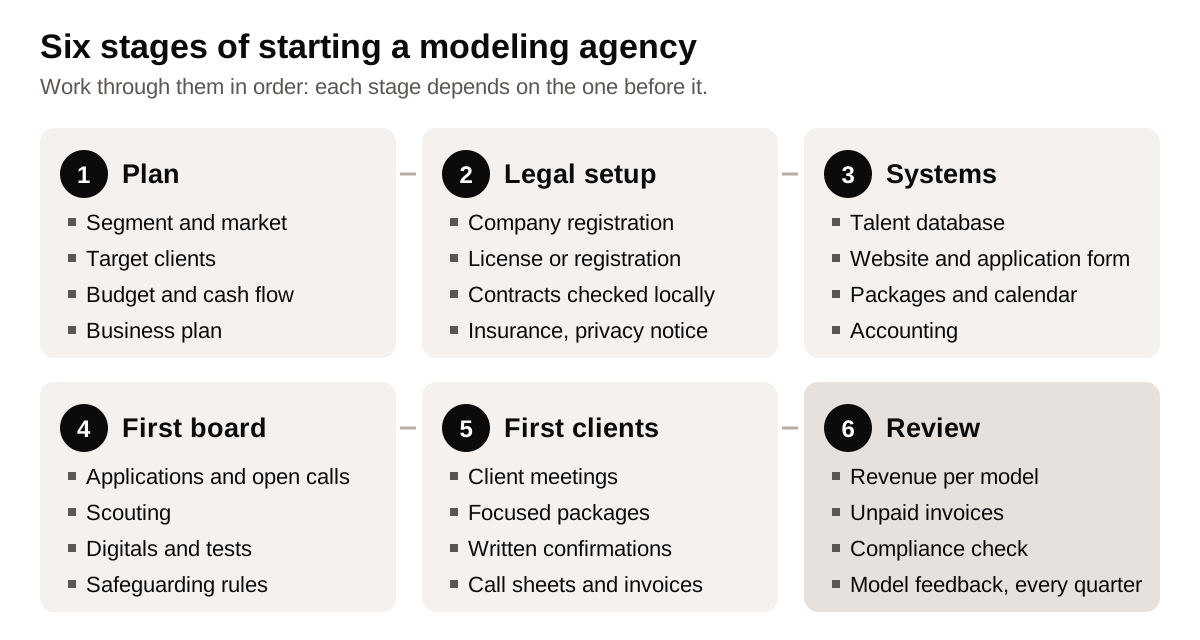
- Plan. Choose your segment and market, list your first target clients and write a simple business plan with your budget and cash flow.
- Set up legally. Register the company, apply for any license or registration, prepare contracts with a local lawyer and buy insurance.
- Build your systems. Database, website with application form, packages, booking calendar and accounting.
- Build your first board. Applications, open calls, scouting and development before promotion.
- Win your first clients. Meet clients in person, send focused packages, book tests and smaller jobs, and deliver reliably.
- Review every quarter. Revenue per model, unpaid invoices, compliance, model feedback and which clients come back.
As you grow, hire bookers who can own client relationships. Our guide to the booking agent role explains what that job involves.
Mistakes to avoid when starting a modeling agency
- Charging models upfront fees. In the UK this is prohibited for fashion and photographic models, and New York's Fashion Workers Act bans fees for signing. Even where it is legal, it damages trust and attracts the wrong applicants.
- Operating without the required license or registration. California prohibits operating a talent agency without a license from the Labor Commissioner, and New York requires model management companies to register before they do business.
- Signing too many models too early. You cannot develop or book a large board with a small team.
- No working capital. Profitable bookings can still leave you unable to pay models on time.
- Contracts copied from the internet. Templates are a start, but have them checked against local law.
- Weak safeguarding. Unclear rules on minors, nudity and chaperones are a legal and reputational risk.
- Ignoring data protection. Applicant photos and documents piling up in email inboxes is how breaches happen.
Starting an agency is a long project. The agencies that last treat their models as long-term partners, keep their paperwork in order and grow at the speed their bookings allow. For current updates from Jurgita Network, see Live.
Frequently asked questions
Do I need a license to start a modeling agency?
It depends on where you operate. Great Britain has no general license for model agencies, but conduct rules apply. California requires a talent agency license from the Labor Commissioner. New York requires an employment agency license in many cases and registration for model management companies under the Fashion Workers Act. Check local rules before you start.
How do modeling agencies make money?
Mainly through commission deducted from models' fees and agency fees invoiced to clients on top of the model's fee. Some agencies also earn from placing models with partner agencies abroad. Rates vary by market and some are capped by law.
Can a modeling agency charge models a registration or signing fee?
In many places, no. UK rules prohibit upfront fees for finding work for fashion and photographic models, and New York's Fashion Workers Act prohibits fees or deposits for signing a contract. Charging upfront fees is also a common sign of a scam, which damages a new agency's reputation.
How many models should a new agency start with?
There is no fixed number. Start with as many as your team can develop and actively book. A small board of models who work regularly builds your reputation faster than a large board of inactive profiles.
Can I run a modeling agency from home?
Many agencies start without a dedicated office, but you need a safe, professional space for castings, digitals and meetings with parents of minors. Check whether your license or registration requires a business address, as some regimes do.
What software does a new modeling agency need?
At minimum: a talent database with profiles and availability, a website with an application form, a way to send packages to clients, a booking calendar and accounting. Many agencies use one platform for the first four and separate accounting software.
Sources
- legislation.gov.uk, Employment Agencies Act 1973
- legislation.gov.uk, The Conduct of Employment Agencies and Employment Businesses Regulations 2003, regulation 26
- California Legislative Information, Labor Code section 1700.15 (talent agency surety bond)
- California Department of Industrial Relations, Talent Agency License and Fee-Related Talent Services
- New York State Senate, General Business Law Article 11, section 172: license required
- New York State Department of Labor, Responsibilities of Fashion Management and Clients (Fashion Workers Act), 2025