Booking Agent: What a Talent Booker Does and How to Become One
What a booking agent does every day: options, confirmations, rate and usage negotiation, model care, the skills agencies hire for and how to become a booker.

A booking agent, often called a booker or talent booker, is the person inside a model or talent agency who turns client interest into paid work. Bookers manage a group of models, answer client requests, place options, confirm jobs, negotiate fees and usage, and look after the practical side of every booking. In most agencies, the bookers are the people clients call first and the people models trust most.
This guide explains the booking agent role from the agency side: what bookers do day to day, how options and confirmations work, how negotiation is handled, what paperwork a booking needs and which skills you should look for when you hire. It also sets out how to become a booker if you are starting out. If you are a model looking for the talent side of the same process, the guides on modeling rates and modeling contracts on jurgita.com are written for you.
In short
- A booking agent manages a board of models, handles client requests and turns options into confirmed, paid jobs.
- The core skills are clear communication, fast scheduling, firm but fair negotiation and real care for the models.
- Every confirmed job needs written terms: fee, usage, hours, overtime, travel, cancellation and payment terms.
- Most bookers start as assistants or in scouting and learn the craft on a booking table, not in a classroom.
What is a booking agent?
In a model agency, the booking agent is the person responsible for a set of models and the clients who book them. Titles vary: booker, agent, model agent, talent booker, booking manager. In large agencies, bookers are split by division (women, men, new faces, commercial, show) and work together on a shared booking table. In small agencies, one or two bookers cover everything, sometimes alongside scouting and accounts.
The booker is not the same as the scout, the casting director or the client's producer. The table below shows how the roles usually divide in a working agency.
| Role | Works for | Main responsibility |
|---|---|---|
| Booker | The agency and its models | Options, confirmations, negotiation, schedules, model care |
| Scout | The agency | Finding and recruiting new talent |
| Casting director | The client or production | Choosing talent for a specific project |
| Producer | The client or production | Budget, crew, locations, call sheets, logistics |
| Accounts | The agency | Invoices, collections, model statements and payouts |
For more on how the client side selects talent, see what a casting director does. For the scouting side, see our guide to the model scout role.
What does a booker do day to day?
No two days are the same, but the rhythm in most agencies is similar. The morning is for planning and confirming, the middle of the day for castings and client calls, and the end of the day for preparing the next day's schedules.
Morning: the schedule
Bookers start by checking what is confirmed for the day, which models need reminders, and which options are about to expire. They send or check call times, addresses and contact numbers, and they answer overnight messages from clients in other time zones.
Midday: requests, packages and castings
Client requests arrive by email, phone and messaging apps: a brand needs three women for an e-commerce shoot next week, a magazine wants a new face for a story, a production company is casting a commercial. The booker checks availability, suggests suitable models and sends a package with current images, digitals and measurements. Castings and go-sees are scheduled around existing jobs.

Speed matters here. The agency that sends a clear, well-chosen package first often gets the option. If your bookers build packages by hand from folders and email attachments, a dedicated system saves hours every week. Agency OS lets bookers create a package from model profiles in a few clicks, send it as a link and see when the client opened it.
Afternoon and evening: confirming and preparing
Options are converted into confirmations, rates and usage are agreed, and the booker sends the confirmed details to the model. Before the day ends, the booker checks the next day's schedule for every model on their list and makes sure nobody is left without a call time.
How do options and confirmations work?
Options are how the industry holds a model's time before a job is certain. Terminology differs slightly between agencies and markets, so agree with each client what each term means, and put it in writing when the stakes are high. The system below is the one most agencies use.
| Term | What it means | What the booker does |
|---|---|---|
| First option | The client has priority on the model's date | Holds the date and sets a time limit for the client to confirm |
| Second option (and lower) | Another client wants the same date but is behind the first | Records it and tells the second client where they stand |
| Challenge | A lower option wants to confirm, so the first option is asked to decide | Gives the first option a short deadline to confirm or release |
| Release | The client drops the option | Moves the next option up and informs everyone affected |
| Confirmation (firm booking) | The job is booked on agreed terms | Sends the written confirmation to the client and details to the model |
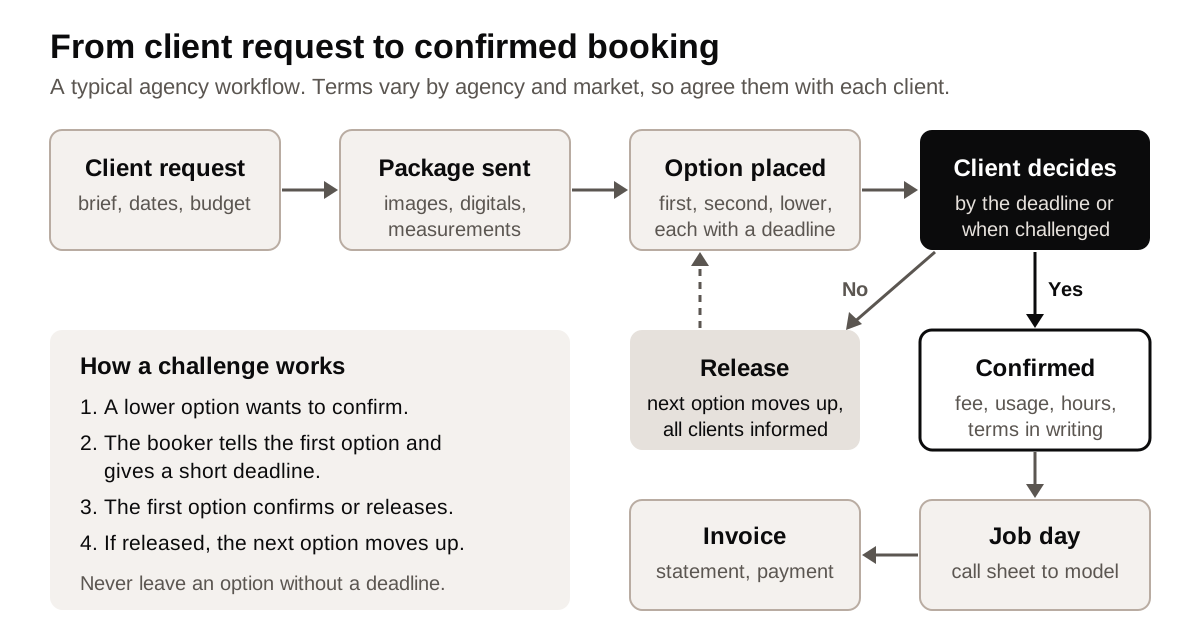
Two rules keep the system fair. First, never let an option sit without a deadline: an open option blocks the model's calendar and costs them other work. Second, tell every client honestly where they stand. Clients forgive a lost option. They do not forgive discovering that their first option was quietly given to someone else.
How does a booker negotiate rates and usage?
Negotiation is where a booker directly affects what the model earns and what the agency earns. The day rate is only one part of it. A booker should agree each of the following before confirming:
- Fee basis: hourly, half day, full day or flat fee for the project.
- Usage: where the images will appear, in which territories and for how long. Usage and buyouts often change the total fee more than the shoot day itself. Our guide to usage and buyout fees explains how they are quoted.
- Overtime: what happens after the agreed hours.
- Travel and accommodation: who pays, travel days, per diems.
- Fittings: whether fittings are paid and at what rate.
- Cancellation and weather: what the client owes if the job is cancelled or postponed.
- Payment terms: when the client pays the agency, and in which currency.
Rates vary widely by market, client type, usage and the model's profile, so there is no fixed price list that works everywhere. What works is consistency: bookers in the same agency should quote from the same logic, and every exception should be agreed with the head booker.

Try it: Commission split calculator, to show a model what they will receive after commission before you accept a rate on their behalf.
What paperwork does a booking need?
A phone call is not a booking. Every confirmed job should have a written confirmation that both the agency and the client can point to later. At a minimum, it should state the client, the model, the date and hours, the fee, the usage, overtime, travel, cancellation terms and payment terms.
Some jurisdictions now set specific rules. In New York, the Fashion Workers Act requires model management companies to give the model a deal memo before work begins, stating the total compensation and payment terms, and to give the model the final booking agreement negotiated with the client within seven days after the booking ends. In the UK, agencies must agree their terms and fees with models in writing before charging any fees. Rules elsewhere differ, so have your confirmation templates checked locally.
On the day itself, the model needs a call sheet: address, call time, contacts, schedule and what to bring. If the client's producer does not send one, the booker should send the essentials.
Try it: Call sheet template, to send models every detail of the shoot day in one clear page.

How does a booker look after the models?
A booker is responsible for people, not only calendars. That means checking that a job is what it claims to be, that the client and location are legitimate, and that the model knows what to expect, especially for nudity, lingerie, travel or late hours. For minors, it means involving parents or guardians and following the child performance rules in the country where the job takes place.
Under New York's Fashion Workers Act, model management companies must use due diligence so that work does not put models at unreasonable risk, and clients must allow models to bring their agent, manager, chaperone or other representative to a job. Wherever you work, a simple internal rule helps: if a booker would not be comfortable explaining a job to the model's family, it needs a second look before it is confirmed.
Model care also covers money. Bookers should know what each model is owed, which expenses have been advanced and when payment is due. Models who understand their statements stay longer.
What skills does a talent booker need?
- Organization: handling dozens of options across many models without losing track.
- Communication: short, clear messages to clients and models, and the ability to say no politely.
- Negotiation: knowing what the job is worth, including usage, and holding a position without losing the client.
- An eye for talent and fit: matching the right model to the brief, not sending the whole board.
- Calm under pressure: last-minute cancellations, delayed flights and sick days are routine.
- Discretion and judgment: bookers see personal information, contracts and fees every day.
- Basic numbers: commission, VAT or sales tax, currency conversion and statements.
How to become a booking agent: step by step
- Learn how the industry works. Read about castings, usage, options and contracts. Follow how campaigns and editorials are produced.
- Get in through an entry role. Most bookers start as an assistant booker, receptionist, scout or intern at an agency, or move over from production or casting.
- Learn on the booking table. Answer phones, update schedules, build packages and watch how senior bookers negotiate.
- Take responsibility for a small group. Many agencies give new bookers a few new faces or a commercial list to develop.
- Build your client relationships. Reliability, quick replies and accurate information are what clients remember.
- Understand the legal basics. Know the rules that apply where your agency works. In California, for example, the Talent Agencies Act treats models as artists, so procuring work for them is a licensed activity for the agency.
- Move up. From booker to senior booker, head of division or agency director, often over several years.
How are bookers paid?
Pay structures vary by agency, market and seniority. Agencies commonly pay a base salary, and many add a bonus or a share of the revenue from the booker's division. Ask any agency you join to explain exactly how its structure works and how targets are measured.
Mistakes to avoid
- Open-ended options. Every option needs a deadline. Unlimited holds cost models other jobs.
- Confirming without usage. If usage is not agreed in writing, it will be argued about later, usually after the images are already published.
- Sending too many models. A package of thirty tells the client you did not read the brief. Send the right five.
- Verbal-only bookings. Confirm every job in writing, with cancellation and payment terms.
- Ignoring the model's side. A booker who never checks travel, safety or payment loses models to agencies that do.
- Inconsistent quotes. Two bookers quoting different rates for the same job damages the agency's credibility.
Strong bookers are the reason clients come back and models stay. If you are building or training a booking team, the agency toolkit has templates to standardize the paperwork, and our guide on how to start a modeling agency shows where bookers fit into the wider business.
Frequently asked questions
What is the difference between a booker and a model agent?
In most agencies the terms are used for the same job: the person who manages models and their bookings. Some agencies use "agent" for senior staff who manage careers and "booker" for those handling daily scheduling, but the work overlaps heavily.
Do you need a degree to become a booking agent?
No specific degree is required. Agencies hire for organization, communication, negotiation and industry knowledge. Experience as an assistant booker, in production, casting or scouting is usually worth more than a qualification.
What is a first option in modeling?
A first option means a client has priority on a model's date before the job is confirmed. If another client wants to confirm the same date, the first option is usually asked to confirm or release within a short deadline.
How many models does one booker handle?
It depends on the division and how busy the models are. A booker developing new faces may handle more people with fewer jobs each, while a booker for established models may handle fewer people with complex schedules. Agencies set this based on workload, not a fixed number.
Does a booking agent need a license?
Usually the agency, not the individual booker, holds any license or registration. In California, talent agencies must be licensed by the Labor Commissioner, and in New York, model management companies must register with the Department of Labor. Rules vary by country and state.
What should a booking confirmation include?
The client, model, date and hours, fee, usage (media, territory, duration), overtime, travel and accommodation, fittings, cancellation terms and payment terms. Keep the same template for every job so nothing is forgotten.
Sources
- New York State Department of Labor, Responsibilities of Fashion Management and Clients (Fashion Workers Act), 2025
- New York State Department of Labor, Fashion Workers Act Definitions: deal memo, model management company, 2025
- GOV.UK, Charge fees as an entertainment and modelling agency: terms and conditions
- California Legislative Information, Labor Code section 1700.4 (Talent Agencies Act definitions)
- California Department of Industrial Relations, Talent Agency License and Fee-Related Talent Services