Usage Fee and Buyout Fee: How Agencies Price Image Rights
How a usage fee and a buyout fee work: media, territory, duration and exclusivity, how bookers build a quote, renewals, overuse and the legal basics.

A usage fee is what a client pays for the right to use a model's image after the shoot is over. The day rate pays for the hours in the studio. The usage fee pays for every poster, banner, social post and packaging run that carries the model's face for months or years afterwards. For most commercial bookings the usage fee, not the day rate, is the larger part of the invoice, and it is the part your bookers have the most room to negotiate.
A buyout fee is a usage fee for a wide package of rights paid up front. Clients like buyouts for the certainty; agencies accept them when the price reflects what is being bought. This guide covers how bookers build a quote from media, territory, duration and exclusivity, how renewals and overuse are handled, and what EU, UK and US law adds.
In short
- The day rate pays for time. The usage fee pays for exploitation of the images: which media, which countries, for how long and with what exclusivity.
- A buyout is a bundle of usage paid in advance. It should still have a defined scope and an end date, never "all media, worldwide, in perpetuity" by default.
- Quote usage line by line so each right has its own price. That makes renewals, extensions and overuse claims much easier.
- Put the usage terms in the confirmation and the invoice. In New York the deal memo must now state usages before the work starts.
What is a usage fee, and how is it different from a day rate?
The day rate, also called the session or booking fee, pays for time worked: the shoot, fittings, paid travel days. It does not change whether the campaign runs for a week or three years.
The usage fee is a license fee for how the images or footage are used: permission to show this person's likeness in defined places for a defined time. More places and more time cost more, because the model gives up more: freshness in the market and sometimes the right to work for competitors.
Editorial work for magazines is usually booked without a separate usage fee because the use is the publication itself. Catalog and e-commerce bookings often include a standard usage period in the rate. Advertising is where usage is priced separately and in detail. Your rate card should say which of these applies to each job type. For the model's side, our sister magazine covers modeling rates in plain terms.
What does a buyout fee actually buy?
"Buyout" is one of the most misused words in booking. It can mean three things; ask which one before quoting.
- A limited buyout: one payment that covers a defined package, for example online and in-store use in one region for one year. The safest form.
- A full buyout: broad media, many territories and a long term, sometimes unlimited. The price must reflect that the model may lose years of work in the category.
- A buyout used as a synonym for "no usage fee": the client expects the day rate to cover everything. That is a request to give rights away; answer it with a usage quote.
Clients also mix up two kinds of rights. The copyright in a photograph usually belongs to the photographer or the production that commissioned it. The model does not own the picture; what the model controls is consent to the commercial use of their likeness. In California, Civil Code section 3344 makes anyone who knowingly uses a person's likeness in advertising without prior consent liable for damages of at least 750 dollars, plus profits and attorney's fees. The UK and EU countries protect image rights through other routes, such as privacy, passing off and data protection, so the usage clause in your confirmation is where consent is defined and limited.
Copyright law itself allows rights to be split. The US Copyright Act lets each exclusive right be transferred separately, and section 90 of the UK Copyright, Designs and Patents Act 1988 allows assignments limited to certain acts or periods. Both require signed writing. The lesson is the same everywhere: rights can be sliced by medium and time, so price them that way and write them down.
Try it: Model release form, a starting template that lets you define media, territory and term in writing instead of granting open consent.
The four dimensions that price usage
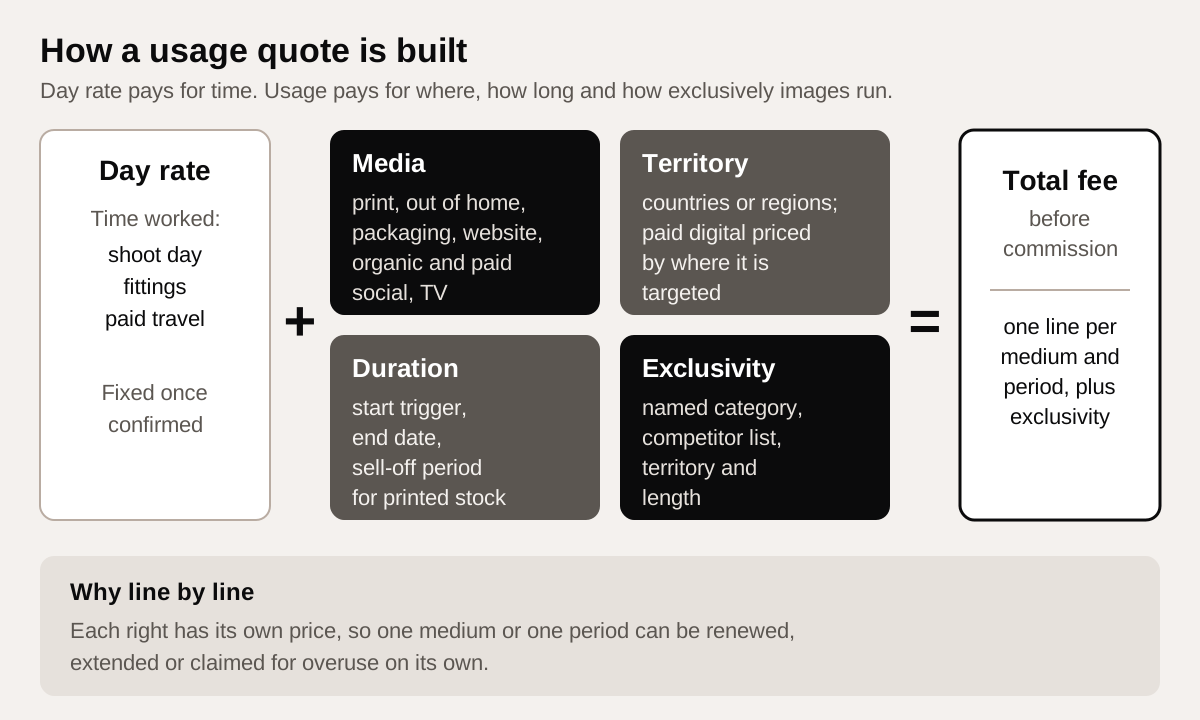
Almost every usage quote is built from four variables. If a brief does not specify all four, go back with questions before giving a number.
| Dimension | What to define | Typical questions for the client |
|---|---|---|
| Media | Each channel listed separately: print, out of home, point of sale, packaging, brand website, organic social, paid social, digital display, TV, cinema, streaming | Will any image be used in paid media? Is packaging included? Are the images going to retail partners? |
| Territory | Countries or regions, plus how online use is treated | Is paid digital geo-targeted? Does the brand's site serve other countries? |
| Duration | Start date, end date, and what triggers the start (first publication or shoot date) | When is the launch? Is there a sell-off period for packaging and printed stock? |
| Exclusivity | Product category, competitor list, territory and length of the restriction | Which competing brands are excluded? Does exclusivity extend beyond the usage period? |
Media
Media is usually the biggest price driver because it reflects reach and commercial intent. Paid media is normally priced above organic posts on the brand's own channels, and out of home and TV are separate lines. Packaging can stay on shelves long after the license ends, so agree a sell-off period in writing.
Territory
A website is visible everywhere, so agencies commonly accept that organic brand-site use is worldwide by nature while pricing paid digital by the territories it targets. Write that distinction into the confirmation.
Duration
Licenses are usually sold in fixed periods such as three months, six months or one year. If the clock starts on first publication, ask the client to notify you of that date, otherwise you cannot know when the term ends. "In perpetuity" should be priced as what it is: the model will never be paid again for that image.
Exclusivity
Exclusivity is a separate payment for what the model cannot do, and it often costs the model more than the usage itself: a year-long category exclusivity can mean turning down better-paid work. Price it as its own line. Name the category precisely, "facial skincare" rather than "beauty", and pay separately for any restriction that outlasts the usage period. Record every exclusivity with its end date on the model's profile so no booker offers the model to a competitor by mistake.
How much is a usage fee?
There is no universal tariff. Usage fees vary by market, model profile, brand size and scope. Some agencies express usage as a multiple of the day rate, others as a percentage per medium per period, others as fixed rate card amounts. What matters is a consistent method in which each element of scope moves the price. The usual upward drivers are paid media, more territories, longer terms, broad exclusivity, a hero position rather than a group shot, and a model the brand is buying for recognition.
A worked example, clearly an example and not a market rate: a booker quotes a day rate of 1,500 for a fashion brand. The client asks for organic social and brand website for one year in three countries, plus paid social for three months in the same countries. The booker's internal rate card prices organic plus website at 50 percent of the day rate per year and paid social at 50 percent per quarter. The usage lines would be 750 and 750, total usage 1,500, total fee 3,000 before commission. If the client then asks to add in-store posters for six months, that is a new line with its own price. And when the client later extends only paid social, you already know what that piece was worth.
Try it: Commission split calculator, to see what the model and the agency receive from the day rate and each usage line after commission.
How to quote usage, step by step
- Collect the full brief. Product, campaign name, shoot dates, number of looks, whether it is stills, video or both, and the four usage dimensions.
- Check conflicts. A model still under a category exclusivity cannot be offered.
- Price each line separately. Day rate, then one line per medium and period, then exclusivity as its own line.
- State what is not included. For example: "TV, cinema and packaging not included and subject to separate quote."
- Confirm in writing. The confirmation should repeat every usage line with dates. If you work in New York, the Fashion Workers Act requires a deal memo before work begins that sets out scope of work, rate of pay, payment term and usages.
- Invoice with the same wording. Finance teams keep invoices; if it repeats scope and end date, renewals are easier.
- Diary the end date. Set a reminder before the license expires so you offer a renewal instead of discovering overuse later.
Whatever system you use to send packages and confirmations, keep the usage terms attached to the booking record. In Agency OS, for example, the client package and the model profiles it points to sit in one place, so you can see later what was offered for which campaign (short demo).

Renewals, extensions and overuse
Brands often want to keep a successful image running after the license ends. That is a renewal, priced as new usage for a new period, usually on the same basis as the original line.
Unions in the US offer a useful model of how cyclical usage can work. Under the 2022 SAG-AFTRA Commercials Contracts, many media types moved to fixed fees for 4-week, 13-week and 1-year use cycles, and where a producer bargains for exclusivity on certain digital uses, it must pay at least one non-creditable holding fee, in the amount of the session fee, for each 13-week period of exclusivity. Fashion and print models are mostly not covered by that contract, but the logic transfers well: usage is bought in periods, and each new period is paid again.
Overuse is when the client keeps using images after the license has ended, or uses them in media that were never licensed. It is more often negligence than bad faith, such as a retail partner keeping an old banner live. A calm process works best.
- Document the use with screenshots, dates and URLs.
- Contact the client with the original confirmation and a renewal quote, not with a threat.
- If the use was outside the licensed media, quote that medium for the period it ran.
- Escalate only if the client refuses to settle, and keep the model informed.
Usage in the EU, the UK and the US: what the law adds
Usage is mostly contract, but the law sets a few boundaries.
- Writing: in the US and the UK a copyright transfer is only effective in signed writing. Even when the client owns the copyright, a written usage clause is your evidence of what the model consented to.
- Fair remuneration in the EU: Directive 2019/790 gives authors and performers who license or transfer rights a right to appropriate and proportionate remuneration, to regular information on how their work is exploited, and to claim more when the original payment proves disproportionately low against later revenues. Whether a given model's work counts as a protected performance depends on national law, so treat this as a principle that supports clear, paid usage rather than an automatic entitlement.
- Likeness consent in the US: California's section 3344 requires prior consent for advertising use, and a parent's or guardian's consent for a minor.
- New York: the Fashion Workers Act requires the deal memo to state usages, and separate written approval, covering scope, purpose, rate of pay and duration, before a model's digital replica is created or used.
Rules differ by country. Have your confirmation and usage clauses checked by a lawyer in each market where you book. For a broader look at how the agency agreement itself handles usage and commission, see our guide to the talent management agreement.
Digital replicas and AI: a new kind of usage
Clients increasingly ask for 3D scans, synthetic variations of campaign images, or the right to generate content from the model's likeness. Treat each as separate usage: a replica can be reused for years without a new shoot and can replace future bookings. Define what may be generated, for which product, in which media and for how long, and who deletes the source files at the end. New York already requires separate written consent for digital replicas; applying that standard everywhere protects the model and your agency.
Mistakes to avoid
- Accepting "all media" without a list. Ask the client to name the media. A list protects the model and helps the client budget accurately.
- Quoting one combined number. A single figure makes it impossible to price an extension of one medium later.
- No start trigger. If the term starts on first publication and nobody records that date, the end date is unknown.
- Vague exclusivity. "Beauty" can block skincare, makeup, haircare and fragrance. Name the category precisely.
- Forgetting the sell-off period. Packaging and printed stock outlive campaigns. Agree how long existing stock may remain in circulation.
- Letting the confirmation and invoice differ. The client's finance team will rely on whichever document they hold. Use the same wording in both.
- Ignoring renewals. An expired license with no follow-up is lost income and an invitation to overuse.
Put the agreed usage on the call sheet too, so the set knows whether video was licensed alongside stills: start from our call sheet template or browse the toolkit. For the casting stage before the quote, see how to run an open casting call and what a casting director needs from you.
Frequently asked questions
Is a usage fee the same as a buyout fee?
A buyout is one form of usage fee. Usage can be priced line by line and renewed period by period, while a buyout bundles a defined package of usage into a single advance payment. Both should have a defined scope and end date.
Does the agency take commission on usage?
Agencies commonly apply their commission to usage in the same way as to the day rate, as set out in the management agreement. Check your own contract terms and any local caps: in New York, for example, commission charged to the model may not exceed 20 percent of the model's total pay.
What happens if a client uses the images after the license ends?
That is overuse. Document it, send the client the original terms with a quote for the extra period, and agree a renewal. Most cases are resolved this way without legal action.
Should social media usage be cheaper than print?
Not automatically. Organic posts on the brand's own channels are often priced lower, but paid social can reach more people than a print run. Price by reach and commercial intent, not by format.
Can a model refuse an in-perpetuity buyout?
Yes. Usage is a negotiated license, and the model and agency can decline terms they consider unfair or offer a limited period instead. If perpetual use is accepted, the fee should reflect that no renewal will ever be paid.
Do editorial bookings carry usage fees?
Editorial work is usually booked without a separate usage fee because the publication is the use. If the publisher or a brand wants to reuse editorial images in advertising, that is new usage and should be quoted.
Sources
- California Legislative Information, Civil Code section 3344, as amended 2025
- U.S. Copyright Office, Copyright Act chapter 2, sections 201 and 204, current
- legislation.gov.uk, Copyright, Designs and Patents Act 1988, section 90, 1988
- EUR-Lex, Directive (EU) 2019/790 on copyright in the Digital Single Market, articles 18 to 20, 2019
- SAG-AFTRA, Summary of new provisions, 2022 Commercials Contracts, 2022
- New York State Department of Labor, Fashion Workers Act: what you need to know, 2025