Talent Management Agreement: The Clauses That Matter to Agencies
The talent management agreement clauses that protect an agency and its models: exclusivity, term, commission, expenses, client money, minors and data.

A talent management agreement is the contract between your agency and the model or talent you represent. It decides who may book them, where, for how long, what you earn, which costs they carry and how either side can walk away. When a booking goes wrong or a model moves to another agency, this document is what everyone reads first, so a vague clause written in a hurry can cost months of commission or a legal dispute.
This guide goes through the clauses that matter most from the agency side: exclusivity, territory, term, commission, expenses, client money, minors and data protection. It compares how the EU, the UK and the US approach them, with New York's Fashion Workers Act and California's Talent Agencies Act as examples. It explains the contract; it is not a template, and every agency should have its agreement checked by a local lawyer before use.
In short
- Define exclusivity, territory and term precisely, with a clear end and a clear notice route. In New York, agreements may not exceed three years or renew without the model's written approval.
- Say exactly what commission is charged on, and check local caps. New York caps commission at 20 percent of the model's total pay.
- List every cost the model may carry and how it is deducted. Show it on each statement.
- Handle client money and minors by the rules of the country where you operate, and protect model data under the GDPR or its local equivalent.
What is a talent management agreement?
It is a representation contract. The model appoints the agency to promote them, negotiate and accept bookings on their behalf, invoice clients and collect payment. In return the agency takes a commission. Depending on the country, the same document may be called a management agreement, a representation agreement or a model agency contract.
It is different from the booking confirmation, which covers one job, and from the agreement between two agencies when a mother agency places a model with another market. Those inter-agency contracts set how the commission is split between agencies, and they should mirror what the model signed, never exceed it. If you want to know how the same contract reads from the model's chair, our sister magazine has a plain guide to the modeling contract.
Which law applies to a model management contract?
The answer depends on where the agency operates and, increasingly, where the work happens. Three examples show how differently markets regulate the same relationship.
| Market | Main framework | What it means for the agreement |
|---|---|---|
| United Kingdom | Employment Agencies Act 1973 and the Conduct of Employment Agencies and Employment Businesses Regulations 2003 | Agencies generally may not charge work-seekers fees for finding work, with limited exceptions for listed occupations including fashion and photographic models. Money held for models must go through a client account. |
| California | Talent Agencies Act, Labor Code sections 1700 onward | Models are expressly "artists". A talent agency needs a license from the Labor Commissioner and must have its contract forms approved; funds go through a trust account. |
| New York | Fashion Workers Act, Labor Law Article 36, in force since June 19, 2025 | Model management companies must register, act in the model's best interest, cap commission at 20 percent, limit contracts to three years and get written approval for renewals and digital replicas. |
| EU member states | National law, with EU rules on data protection and young workers | No single EU agency law. The GDPR governs model data, and Directive 94/33/EC requires prior authorization for children working in advertising and similar activities. |
The UK fee rule is in section 6 of the Employment Agencies Act 1973, and California's definition of a talent agency, which names models among artists, is in Labor Code section 1700.4, with the license requirement in section 1700.5. Do not assume one country's rules apply everywhere. An agency that books in several markets needs an agreement that respects the strictest regime it works under, or separate versions per market.
Exclusivity and territory: what to write
Exclusivity is the heart of the agreement. It decides whether the model can work through other agencies or directly with clients. Typical structures are:
- Exclusive worldwide: the agency, usually acting as mother agency, controls all representation and places the model with other agencies under inter-agency contracts.
- Exclusive in a territory: the agency represents the model only in one city or country, and other agencies may represent the model elsewhere.
- Non-exclusive: common for commercial and lifestyle talent, where several agencies may submit the same person and the one that books the job takes the commission.
Write down what counts as the territory, which work types are covered (fashion, commercial, influencer and creator work, acting), and what happens with work the model finds on their own. Direct bookings are a frequent source of disputes. Decide in advance whether the agency commissions them, and say so plainly. New York's definition of exclusive representation is an agreement that restricts the model from other representation for similar work, so make sure the scope of "similar work" is clear in your text.

Term, renewal and termination
A fixed term with a clear end date protects both sides. Agencies commonly use initial terms of one to three years, but the right length depends on local law. In New York, a model management company may not require a contract longer than three years, and the contract may not renew without the model's written approval. An automatic rollover clause that works in one market can be unlawful in another.
Termination clauses should cover:
- Notice: how much notice either side gives, and in what form, for example written notice by email to a named address.
- Termination for cause: unpaid earnings, serious misconduct, or breach of the duties in the contract, with a short period to fix the problem where it can be fixed.
- Post-term commission: whether the agency keeps commission on bookings it negotiated before the end date, including later usage renewals of those jobs. Limit it to work the agency actually originated.
- Handover: return of materials, transfer of the portfolio and digitals, and closure of the online profile within a set time.
Commission: what it is charged on, and how much
The commission clause must answer three questions. What is the rate? What is it calculated on: the day rate only, or usage, overtime, travel days and buyouts too? And is it deducted from the model's fee, charged to the client on top as an agency fee, or both?
Agencies commonly charge commission to the model and, separately, a service fee to the client. Both should be visible: the model's statement should show the gross fee and the commission, and the client invoice should show the agency fee. Rates vary by market and by type of work, so there is no universal figure. Some markets set a ceiling: in New York, a model management company may not charge commission greater than 20 percent of the model's total pay.
A worked example, for illustration only: a job pays a 2,000 day rate and 1,000 usage. With a 20 percent commission on both, the model's commission is 600 and the model receives 2,400 before any agreed deductions. If the contract says commission applies to the day rate only, the commission is 400. The difference is entirely in the wording.
Try it: Commission split calculator, to test how different commission bases and agency fees change what the model and the agency receive.
Usage deserves its own sentence in the clause, because usage renewals can arrive years after the shoot. Our guide to usage and buyout fees explains how those lines are priced.
Expenses, deductions and client money
Expenses and advances
Agencies often pay up front for things that help a new model work: test shoots, printed cards, website profiles, travel to another market, sometimes accommodation. The agreement must say which of these the model repays, how they are recorded, and whether they are deducted from earnings or invoiced.
- List the categories of recoverable cost in the contract, not in a separate policy the model never saw.
- Require the model's approval for any single cost above an agreed amount.
- Show each deduction on the statement with a date and a receipt reference.
- Say what happens to unrecovered advances if the agreement ends.
Some charges are restricted by law. In New York, an agency may not require a deposit or collect a fee for signing a contract, and must clearly tell models which items they will pay for through deductions. In the UK, the general rule in the Employment Agencies Act 1973 is that agencies may not charge work-seekers fees for finding them work; the Conduct Regulations allow some narrow exceptions for listed occupations, which are worth reading carefully before you introduce any charge. A fee to "join the agency" is also a classic sign of a modeling scam, which we cover in our guide for the model scout.
Client money and payment timing
Most agencies invoice the client, receive the fee and pay the model after deducting commission and costs. That makes the agency a holder of the model's money, and several jurisdictions regulate how long and where it may be held.
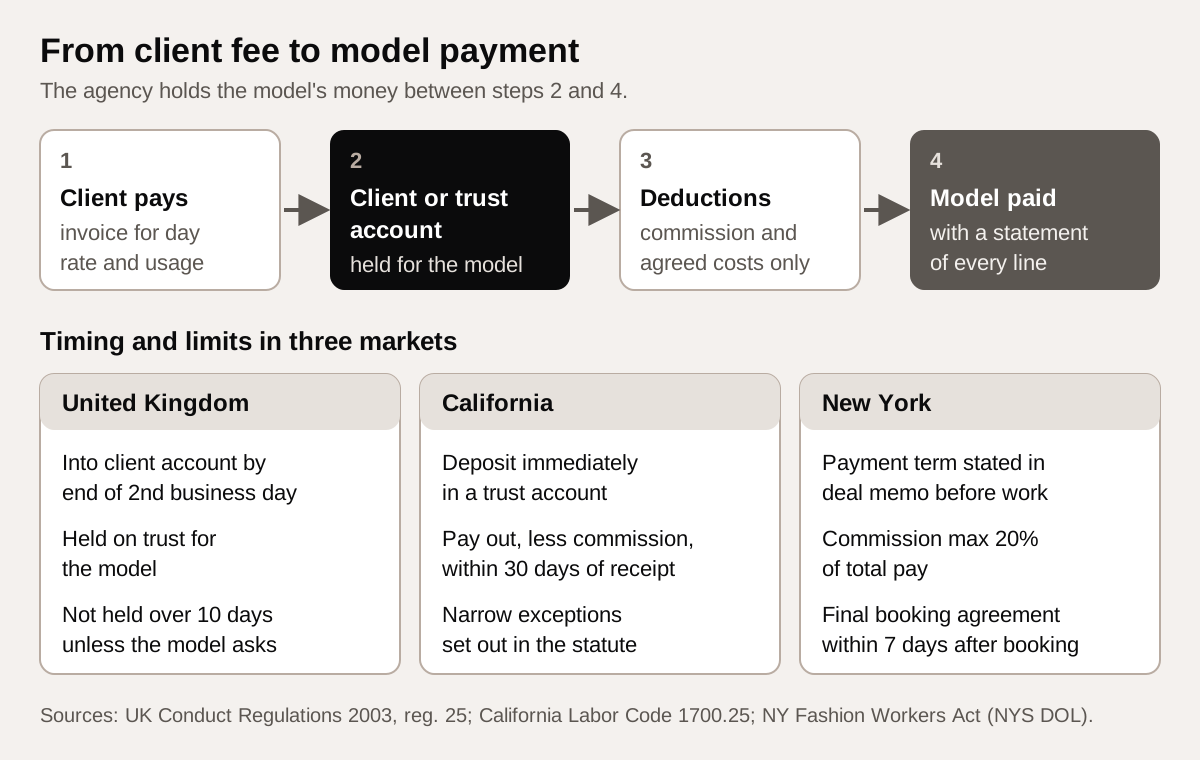
- United Kingdom: under regulation 25 of the Conduct Regulations, money received for a model must be paid into a client account by the end of the second business day after receipt, held on trust for the model, and not kept longer than ten days unless the model asks for that.
- California: under Labor Code section 1700.25, a licensed talent agency must deposit funds in a trust account and pay them, less commission, within 30 days of receipt, with narrow exceptions.
- New York: the deal memo sent before work starts must state the payment term, and the model must receive the final booking agreement within seven days of the end of the booking.
Write the payment period into your agreement, and keep it at least as strict as the local rule. Explain what happens when a client pays late: whether the agency pays the model only after receipt, and whether it pursues the debt.

Minors: consent, licenses and chaperones
When the model is a child, the parent or legal guardian signs, and the agreement should say so on the first page. Beyond signature, two layers of rules apply. In the EU, Directive 94/33/EC requires prior authorization from the competent authority before children are employed for performance in cultural, artistic, sports or advertising activities, and national law sets the details. In England, Wales and Scotland, section 37 of the Children and Young Persons Act 1963 requires a local authority license where a child works as a model and payment is made beyond expenses.
Your agreement for a minor should include: who signs and who is the contact for bookings, how school time is protected, who accompanies the child on set, how earnings are held, and when the agreement must be reviewed as the child grows. In the US, rules vary by state, and some, such as California's likeness statute, expressly require a parent's or guardian's consent for advertising use of a minor's image.

Data protection, image rights and digital replicas
An agency holds a lot of personal data: measurements, photographs, passport copies, bank details, sometimes health information relevant to a job. Under the GDPR, personal data must be limited to what is necessary for the purpose and kept no longer than needed, and health data is a special category that may only be processed under one of the conditions in Article 9. Your agreement, or a privacy notice it refers to, should say what you collect, why, who receives it (clients, partner agencies, photographers) and how long you keep it after the agreement ends.
Image rights belong in the agreement too. State that the agency may use the model's images to promote them during the term, and that the model approves usage for each booking through the confirmation. Treat digital replicas separately: New York requires a model's written approval for creating or using a digital replica, separate from the representation agreement. Keeping profiles, permissions and client packages in one system helps here. Agency OS, for example, keeps model profiles and the packages you send to clients in one place, which makes it easier to see what was shared with whom; you can see how it works in a demo.
Try it: Model release form, a template for recording a model's consent to specific media, territory and term for each job.
How to review a talent management agreement, step by step
- Map where you operate. List the countries and states where you sign models and where they work. Each may add rules.
- Check the scope. Exclusivity, territory and work types should match how you actually book.
- Check term and exit. Fixed term, renewal by written approval, clear notice, fair post-term commission.
- Rebuild the money trail. Commission base and rate, agency fees, recoverable costs, client account, payment period, statements.
- Add the special cases. Minors, digital replicas, travel to other markets, inter-agency placements.
- Plain English pass. If a model cannot explain a clause back to you, rewrite it.
- Local legal review. Have the final version checked in each jurisdiction where you use it.
Mistakes to avoid
- One contract for every market. A clause that is normal in one country can be unlawful in another.
- Automatic renewal. Unlawful in New York without written approval, and a source of disputes elsewhere.
- Commission on "all earnings" without definition. Say whether it includes usage, direct bookings, influencer work and post-term renewals.
- Unlisted costs. Any deduction the contract does not describe will be challenged.
- Holding money too long. Follow the client money rules where you operate and pay on a stated schedule.
- Inter-agency contracts that exceed the model's. A partner agency cannot be given rights the model never granted to you.
Frequently asked questions
How long should a talent management agreement last?
Agencies commonly use terms of one to three years, but the right term depends on local law. In New York a model management company may not require a contract longer than three years, and renewal needs the model's written approval.
Can an agency charge a model a fee to sign?
In New York, no: an agency may not require a deposit or collect a fee for signing. In the UK, agencies generally may not charge fees for finding work, with narrow exceptions. Upfront joining fees are also a common scam sign.
Is commission charged on usage fees?
Only if the agreement says so. Most agencies include usage in the commission base, but the clause must state it, together with whether later usage renewals are covered after the agreement ends.
Who signs for a model under 18?
The parent or legal guardian signs. Local rules may also require a license or authorization for the child's work, and limits on hours and supervision on set.
What is a post-term commission clause?
It lets the agency keep commission on work it negotiated before the agreement ended, such as a campaign that pays later or a usage renewal. It should be limited to work the agency originated and to a defined period.
Do we need a separate privacy notice?
Under the GDPR you must tell models what data you collect, why and for how long. Many agencies put this in a separate privacy notice referred to in the agreement, which is easier to keep up to date.
Sources
- New York State Department of Labor, Fashion Workers Act: what you need to know, 2025
- California Legislative Information, Labor Code section 1700.23, talent agency contract forms
- California Legislative Information, Labor Code section 1700.25, trust account and disbursement
- legislation.gov.uk, Conduct of Employment Agencies and Employment Businesses Regulations 2003, regulation 25, 2003
- EUR-Lex, Regulation (EU) 2016/679, General Data Protection Regulation, 2016
- EUR-Lex, Council Directive 94/33/EC on the protection of young people at work, 1994