Mother Agency: How It Works, Gets Paid and Places Models Abroad
What a mother agency does, how it develops talent and places models in other markets, how it gets paid, and what the agreement between agencies should cover.

A mother agency is the agency that first signs a model, develops them and then manages their career across other markets. When a model from a smaller city works in Milan, Paris, New York or Tokyo, the agencies there usually represent the model locally, while the mother agency stays responsible for the long-term plan. For an agency owner, running a mother agency well is one of the most reliable ways to build value from a board, because it lets a small team earn from careers that grow far beyond its home market.
This guide is written for agency owners and bookers. It covers what a mother agency actually does, how it develops and places talent, how it gets paid, what the agreement between a mother agency and a placing agency should contain, and where the law in the UK, the US and the EU affects the setup. If you are a model reading this, the model-side view of contracts and agencies is covered on jurgita.com.
In short
- A mother agency discovers or signs a model, develops them and places them with agencies in other markets while keeping a say in the career.
- It is usually paid either from the placing agency's commission or by a separate commission on the model's earnings. The agreement must say which, in writing.
- The agency-to-agency agreement should cover territory, commission, advances, expenses, reporting, communication and how the deal ends.
- Local law can cap commission, set contract terms or require registration, so have your setup checked in each market you work with.
What is a mother agency?
The term describes a role, not a legal category. A mother agency is the agency that holds the primary relationship with a model, usually because it scouted them or signed them first. When the model works in another market, a local agency there (often called the placing agency or the local agency) handles day-to-day bookings, castings and client contact in that city. The mother agency stays in the background as the model's long-term manager.
In practice, the mother agency decides which markets a model is ready for, when to go, for how long and with which local partner. It keeps the full picture: earnings across markets, advances, wellbeing, school or family situation and the career plan. The placing agency sees one market and one season. The mother agency sees the whole career.
Mother agency, placing agency and local agency
The terms overlap, and one agency often plays both roles: mother agency for models it scouted, placing agency for models sent from abroad.
| Role | Main job | Typical relationship with the model | Usual source of income |
|---|---|---|---|
| Mother agency | Scouting, development, career planning, choosing markets and partners | Long term, often several years | Share of placing agency commission or separate commission from the model |
| Placing (local) agency | Castings, options, bookings, client relationships in its own market | Season or contract length in that market | Commission from the model and agency fee from the client |
| Agency acting in both roles | Develops its own scouted models and receives models from partners | Mixed | Both of the above, depending on the model |
What does a mother agency do day to day?
Most of the work happens before a model ever travels. Send unprepared models abroad and you lose the trust of placing agencies, which is the asset the whole model depends on.
Scouting and signing
The mother agency finds talent through street scouting, open calls, online applications and referrals. Our guides on the model scout role and on running an open casting call cover that stage in detail. Once a model is signed, the mother agency is responsible for checking age, consent from parents or guardians for minors, and the right to work in the markets you plan for them.
Development
Development means turning potential into a book a placing agency can sell: regular digitals, test shoots, walking practice, local work and coaching on castings and communication. It also means an honest decision about which segment the model fits.

Career management while the model is abroad
While a model is placed, the mother agency stays in contact with both the model and the placing agency, checking the schedule, statements, housing costs and how the model is coping. Together with the model it decides when to extend a stay, when to come home and which market comes next, and it plans the longer arc from development markets to major ones, and later perhaps to commercial work.
How does a mother agency place a model with another agency?
Placement is a sales process between professionals. You are asking another agency to invest its bookers' time, and often its money, in a model it has never met.
- Choose the market. Match the model to what the city buys (editorial and shows, or catalogue and commercial), and check season timing, visas and schooling.
- Shortlist placing agencies. Look at who already works well with models of a similar type.
- Send a clean package. Current digitals, a short selection of the best book images, measurements taken recently, age, nationality, visa status, available dates and a short note on what the model has already done. A package that opens on any phone and is easy to forward to clients gets answered faster.
- Agree terms before the model travels. Commission split, who pays travel, housing rates, pocket money advances, the length of the stay and reporting. Put it in writing.
- Prepare the model. Explain the schedule, the costs they may owe, how statements work and who to call if something goes wrong.
- Follow up every week. Ask for castings, feedback, options and the running statement. Do not wait for the end of the stay to find out it went badly.
Sending packages is where many agencies lose time. With profiles, digitals and measurements in one place, a package for a partner takes minutes. Agency OS handles exactly that: model profiles, packages for clients and partner agencies, and tracking which links were viewed.
How is a mother agency paid?
There is no single standard, and you should never assume your partner works the same way you do. Two structures are common in the industry, and some agencies combine them.
Structure 1: a share of the placing agency's commission
The placing agency takes its usual commission from the model's earnings and passes part of that commission to the mother agency. The model pays one commission in total. This is simple for the model to understand and keeps the total deduction in line with what the model would pay to any single agency.
Structure 2: a separate commission from the model
The mother agency charges the model its own commission, usually calculated on what the model actually receives from the placing agency. The model then pays two commissions on the same job. This must be explicit in the model's contract with the mother agency, and the model must understand it before signing.
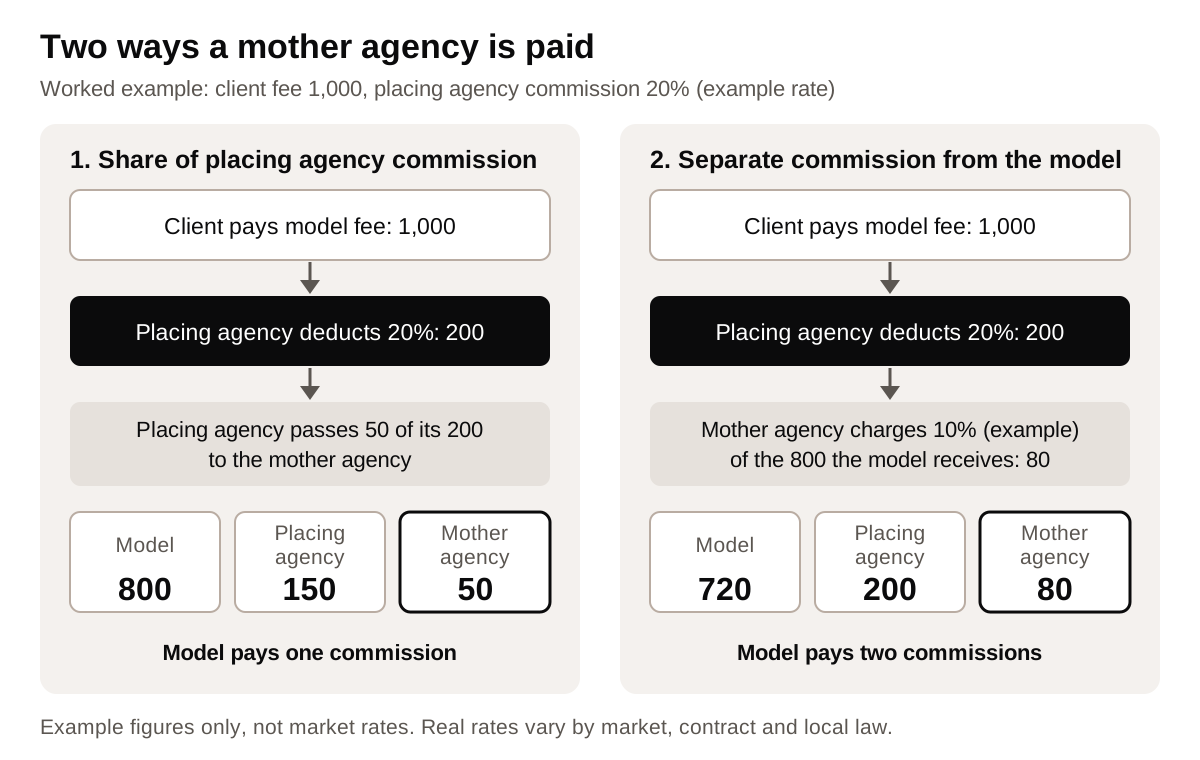
A worked example
The figures below are an illustration, not market rates. Suppose a model earns a fee of 1,000 from a client booked through a placing agency, and the placing agency's commission on the model is 20 percent in this example.
- Structure 1: the placing agency deducts 200 and pays the model 800. It then passes 50 of its 200 to the mother agency under their agreement. The model receives 800, the placing agency keeps 150, the mother agency receives 50.
- Structure 2: the placing agency deducts 200 and pays 800 to the model (or to the mother agency for the model). The mother agency then charges, in this example, 10 percent of the 800, which is 80. The model receives 720, the placing agency keeps 200, the mother agency receives 80.
Many agencies also invoice clients an agency or service fee on top of the model's fee. That amount belongs to the agency that invoiced it and is normally not shared, unless your agreement says otherwise.
Try it: Commission split calculator, to check what the model, the placing agency and your agency each receive under both structures before you agree terms.
Expenses and advances
Placing agencies often advance travel, housing and pocket money, then recover them from the model's earnings. Make sure the model knows these costs in advance and that the statement matches. A model who comes home with debt will leave your agency. If you want to understand the model's side of these costs, how much models make on jurgita.com explains it from their perspective.
What should the agreement between a mother agency and a placing agency include?
Many placements still run on an email and a handshake, until something goes wrong: an unpaid statement, a model who wants to switch agencies, or a dispute about a job booked after the model left. A short written agreement prevents most of these.
- Parties and the model. Name both agencies and the model, and confirm the mother agency has the right to place the model.
- Territory and term. Which market or markets, from which date, for which period, and whether the placing agency is exclusive there.
- Commission. Which structure applies, the percentage or amount due to the mother agency, and on which revenue it is calculated (model fee only, or also usage and buyouts).
- Payment and reporting. When the placing agency pays the mother agency, in which currency, and how often it sends statements for the model.
- Advances and expenses. What the placing agency may advance, at what rates, and the maximum before it needs approval.
- Communication. Who speaks to the model about career decisions, and how quickly each side shares problems.
- Post-term commission. What happens to jobs negotiated during the term but shot or paid later, including renewals of usage.
- Ending the relationship. Notice periods, what happens if the model leaves either agency, and how final statements are settled.
- Data protection. How each agency handles the model's personal data, and on what legal basis data is shared across borders.
- Applicable law. Which country's law governs the agreement and where disputes are handled.
The model-side contract matters as much as the agency-to-agency one. Your agreement with the model must reflect the structure you agree with partners, particularly if you charge a separate commission. Our guide to the talent management agreement covers the clauses that matter most.

Which laws affect a mother agency?
Rules differ by country and sometimes by state or city. The examples below show why you cannot copy one market's practice into another. Have your contracts checked locally in every market where you sign models or send them.
United Kingdom
The Employment Agencies Act 1973 generally prohibits agencies from charging work-seekers fees for finding them work. The Conduct of Employment Agencies and Employment Businesses Regulations 2003 make exceptions for listed occupations, including photographic and fashion models: under regulation 26 an agency may charge such a model a commission out of their earnings, subject to conditions, including rules that apply when the agency also charges the hirer. GOV.UK guidance confirms that agencies cannot charge models any upfront fee for finding work, including for putting them in a publication or on a website, and that fees must be agreed in writing before the agency starts looking for work.
United States: New York
The New York State Fashion Workers Act (Labor Law Article 36) applies to model management companies doing business in New York. According to the New York State Department of Labor, these companies must not charge a commission greater than 20 percent of a model's total pay, must not require representation agreements longer than three years or that renew without the model's written approval, and must give models a deal memo before work begins. Model management companies and groups must also register with the Department from December 21, 2025. If you place models with New York agencies, or a New York agency acts as your partner, check with counsel how the cap applies when two agencies take commission from the same job.
United States: California
California's Talent Agencies Act defines "artists" to include models, and procuring engagements for them requires a talent agency license from the Labor Commissioner. If you would procure work in California yourself rather than through a licensed local agency, take advice first.
European Union
Rules on agency fees and representation contracts are national and vary by member state. Common to all is the General Data Protection Regulation: sharing a model's images, measurements, documents and earnings with a partner agency is processing of personal data, and sending it outside the European Economic Area needs a lawful transfer mechanism.
How to become a strong mother agency: step by step
- Decide your segment. Pick the type of model you can develop well and the markets that buy them. A focused board places better than a broad one.
- Build a development routine. Fixed days for digitals, tests and walking practice. Update measurements and images on a schedule, not when a partner asks.
- Build a partner list per market. Two or three trusted agencies per city, with notes on what they book well.
- Standardize your terms. Prepare a short agency-to-agency agreement and a matching clause in your model contract.
- Prepare every model before travel. Budget, housing, schedule, emergency contacts and an honest talk about expectations.
- Track statements and payments. Reconcile what partners report with what the model received and what you invoiced.
- Review each placement. Record what the model earned and whether you would use that partner again.

Mistakes to avoid
- Placing too early. A model without strong digitals, a few good tests and basic casting skills will cost the placing agency money, and your reputation goes with them.
- Unclear commission. If the model only discovers a second commission on their first statement, you will lose the model and probably the partner too.
- No written terms with partners. Disputes about post-term jobs and usage renewals are almost impossible to settle on memory.
- Ignoring advances. Housing and travel debt can wipe out a model's earnings. Agree limits and check statements during the stay, not after.
- Losing contact. Weekly contact with both the model and the partner is the minimum.
- Copying rules from another country. A commission rate or contract length that is normal in one market may be unlawful in another.
Mother agency work rewards patience and clear paperwork. For templates, see the agency toolkit, and for the daily side of placements, read our guide to the booking agent role.
Frequently asked questions
What is the difference between a mother agency and a modeling agency?
Every mother agency is a modeling agency. The term describes the agency's role for a particular model: it signed and developed the model and manages the career across markets, while local agencies in other cities handle bookings there.
Does a model pay two commissions when they have a mother agency?
It depends on the agreement. In one common structure the placing agency shares its commission with the mother agency, so the model pays one commission. In another, the mother agency charges its own commission on what the model receives. The model's contract must state which applies, and some jurisdictions cap the total.
Can a model have more than one mother agency?
Normally not. The mother agency role exists so that one agency holds the career plan. A model can have several placing agencies in different markets, but two agencies claiming the mother role for the same model leads to conflict over commission and decisions.
How long does a mother agency agreement last?
Terms vary by agency and by country. Some laws limit contract length: in New York, for example, the Fashion Workers Act prohibits requiring representation agreements longer than three years or that renew without the model's written approval. Check the rules where you and the model are based.
Who pays for a model's travel and housing abroad?
Usually the placing agency advances these costs and recovers them from the model's earnings, as agreed in advance. The mother agency should make sure the model knows the rates and limits before travelling and should check the statements during the stay.
Sources
- legislation.gov.uk, The Conduct of Employment Agencies and Employment Businesses Regulations 2003, regulation 26
- GOV.UK, Charge fees as an entertainment and modelling agency: fees for fashion and photographic models
- New York State Department of Labor, Responsibilities of Fashion Management and Clients (Fashion Workers Act), 2025
- California Legislative Information, Labor Code section 1700.4 (Talent Agencies Act definitions)
- EUR-Lex, Regulation (EU) 2016/679, General Data Protection Regulation, 2016