Influencer Contract Template: Clauses, Usage and Disclosure
What an influencer contract template must cover from the agency side: deliverables, usage rights, exclusivity, approvals, payment and US, UK and EU ad disclosure.

An influencer contract template saves your team from rebuilding the same agreement for every campaign, but only if it covers the points that cause real disputes: what exactly gets posted, who can reuse the content and for how long, what the creator may not promote, and how the ad is labeled. For an agency that represents creators, it is also where you protect your commission.
This guide goes through each clause from the agency side. It explains what belongs in a template, how usage and exclusivity change the fee, and what the disclosure rules in the United States, the United Kingdom and the European Union expect from brands, creators and the intermediaries who connect them. Rules differ by country and change over time, so have your final template checked by a lawyer in each market where you sign deals.
In short
- Define deliverables by platform, format, quantity, posting window and how long each post stays live.
- Separate organic posting from paid usage and whitelisting, and price each one with its own territory and duration.
- Write the disclosure rule into the contract. US, UK and EU regulators all expect paid content to be clearly labeled, and in the US a company that pays and directs influencers can be held responsible too.
- Fix approval rounds, payment dates, kill fees and termination before any content is made.
What is an influencer contract and who signs it?
An influencer contract is the agreement under which a brand, or the brand's agency, pays a creator to produce and publish content. On paper it looks like two parties. In practice there are often four: the brand, its media or PR agency, your management agency, and the creator. Before you draft anything, decide which of two common structures you are using.
- Agency as agent. The contract is between the brand and the creator. Your agency negotiates, signs on the creator's behalf under the authority in your management agreement, and takes commission. The creator carries the obligations to deliver.
- Agency as principal. Your agency contracts with the brand in its own name, invoices the full fee, and engages the creator under a separate agreement. You carry the delivery risk, and you also control the cash.
The choice affects liability, invoicing and tax. Your agreement with the creator, covered in our guide to the talent management agreement, should state which structure you may use and when. This article deals with the campaign contract itself.
What should an influencer contract template include?
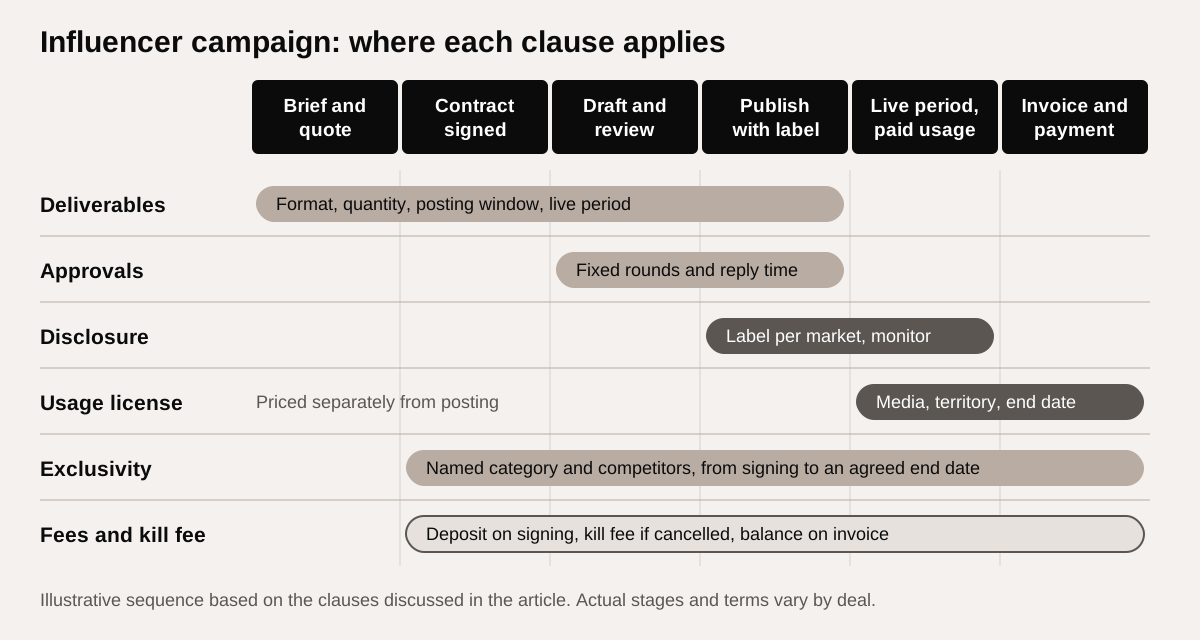
A good template is a fixed body of terms plus a short schedule that changes per campaign. Bookers fill in the schedule; the terms stay stable and reviewed. The table below lists the clauses agencies commonly include and what each one settles.
| Clause | What it settles | What your agency should check |
|---|---|---|
| Parties and roles | Who contracts, who delivers, who pays | Agent or principal structure, signing authority |
| Deliverables schedule | Platforms, formats, quantities, dates | Posting window, time zone, live period |
| Approvals | Review rounds and response times | What happens if the brand does not reply |
| Usage and license | Who may reuse the content, where and how long | Organic, paid and whitelisting priced separately |
| Exclusivity | Which competitors the creator must avoid | Narrow category, fixed dates, separate fee |
| Disclosure | How the ad is labeled in each market | Label wording, placement, monitoring duty |
| Fees and payment | Amounts, invoicing, due dates | Deposit, payment term, late payment |
| Cancellation | Kill fee and rescheduling | Payment for work already done |
| Termination and conduct | When either side can end the deal | Mutual, specific triggers |
| Data and confidentiality | Personal data, campaign information | Purpose, retention, who sees audience data |
| Governing law | Which courts and laws apply | Matches where you can realistically enforce |
How do you define deliverables so nobody argues later?
Most influencer disputes start with a vague line such as "three posts in March". Write every deliverable so a person who has never seen the brief could check it.
- Platform and account: the exact handle the content goes on, and whether cross-posting to other platforms is included.
- Format: feed post, carousel, short vertical video, story frames, livestream, or an integration inside long-form video. For video, state the length range.
- Quantity: number of pieces, and for stories, the number of frames.
- Posting window: dates, times and time zone. A brand launch often depends on the hour, not the day.
- Live period: how long each post must stay published, and whether the creator may archive it afterwards.
- Caption elements: brand tag, link, discount or affiliate code, and the disclosure label.
- Extras: raw files, behind-the-scenes clips, or a reporting screenshot of post insights within an agreed number of days.
Add a line for platform changes: if a post is taken down for reasons outside the creator's control, say whether a replacement is owed.
Usage rights: organic posting, paid usage and whitelisting
The fee for making and posting content is not the same as the fee for letting a brand reuse it. The contract should say who owns the content and exactly what license the brand receives. A creator posting on their own account is one right. The brand running that video as a paid ad for six months in five countries is a different, larger right. Our guide to usage and buyout fees explains how agencies price media, territory and duration.
| Right granted | What the brand gets | What to specify |
|---|---|---|
| Organic posting | The post on the creator's channel | Live period, no edits by the brand |
| Brand reposting | Sharing on the brand's own social accounts | Accounts allowed, duration, credit to creator |
| Paid usage | Running the content as an ad from brand accounts | Media, territory, start and end date, edits allowed |
| Whitelisting or creator licensing | Running ads through the creator's handle | Duration, ad copy approval, comment handling, access removal |
| Other media | Website, email, retail screens, print, outdoor | Each medium named, with its own term |
| Buyout | Broad or unlimited use | Priced as a buyout, never by default |
Whitelisting needs extra care because the ads appear under the creator's name. Agree who writes the ad text, whether the creator approves it, how long access lasts, and that access is removed on the end date. Agencies commonly add a renewal clause: if the brand wants to keep running content after the term, it pays a set renewal fee or asks first.
Exclusivity and competitor clauses
Exclusivity is a payment for income the creator gives up, so it should be specific and priced. "No beauty brands for a year" can wipe out a creator's main category. A workable clause names the product category narrowly (for example, facial sunscreen rather than skincare), lists named competitors where possible, sets a start and end date, and says whether it covers only paid work or also gifted and organic mentions.
Ask the creator to declare existing commitments before signing, and record every exclusivity in your booking system with its end date. Your booking agents should see a conflict before they put a creator forward, not after the brand finds an old post.
Disclosure rules in the US, UK and EU
US, UK and EU rules all treat undisclosed paid content as misleading. The detail differs, so the contract should state the label for each market.
United States
The FTC's Endorsement Guides (16 CFR Part 255) require a material connection between endorser and brand to be disclosed clearly and conspicuously when the audience would not expect it. A material connection includes payment and free or discounted products, even when the brand did not require a post. "Clear and conspicuous" means difficult to miss and easily understandable; where a claim is made in both video and audio, the disclosure should be in both. The FTC's influencer guide adds: put the disclosure with the endorsement, not only on a profile or behind a "more" link, keep it out of hashtag clusters, and repeat it during livestreams.
Responsibility is shared. The Guides say advertisers can be liable even when the endorser is not, and should guide, monitor and correct their endorsers. The FTC's own question and answer page goes further for intermediaries: a company that recruits, pays and directs influencers could be liable if they fail to disclose, and needs reasonable training and monitoring programs. It suggests monitoring for the length of the contract and a reasonable time after, such as a few months.
United Kingdom
The CMA's guidance for content creators says labels such as "ad", "advert" or "advertisement" should appear in a clear, upfront position. It lists terms to avoid, including "#gifted", "#spon", "#sponsored", "#collab", "in association with", "thank you" and simply naming the brand. The joint ASA and CMA influencers' guide (third edition, 2023) covers the same ground with examples; the ASA notes it will be updated for the Digital Markets, Competition and Consumers Act 2024, which replaced the earlier consumer protection regulations.
European Union
The Unfair Commercial Practices Directive lists, among practices that are unfair in all circumstances, using editorial content to promote a product where the trader has paid for it without making that clear. Member states implement the directive and their regulators publish their own labeling guidance, so check the national rule for each market.
| Label or method | US (FTC staff guidance) | UK (CMA guidance) |
|---|---|---|
| "Ad", "Advertisement" | Acceptable | Acceptable, upfront |
| "Sponsored" | Acceptable | Listed as a term to avoid |
| "Gifted" | Plain wording such as thanks for the free product is often enough | Listed as a term to avoid |
| "Spon", "sp", "collab" | Avoid | Avoid |
| Platform paid partnership tool | Use in addition to your own disclosure | Acceptable if clear, otherwise add "#Ad" upfront |
Turn this into contract language: the creator labels every paid piece in the form set out in the schedule for each market; the brand may not ask for the label to be removed or softened; the agency checks posts at publication; and any missing label is fixed within a set number of hours.
Approvals, revisions and what creators may say
Approvals protect the brand, but open-ended approvals kill timelines. Agencies commonly allow one or two rounds of changes on the concept and one on the final cut, with a fixed response time for the brand. Say what happens if the brand misses that time: the post date moves, or the draft is treated as approved. A request that changes the brief after filming is a reshoot and should be paid.
The content of the post also has legal limits. The FTC Guides require endorsements to reflect the endorser's honest opinion and experience, and the FTC's influencer guide says creators cannot talk about a product they have not tried or make claims the advertiser cannot prove. Ask the brand for a written list of approved claims, and include a clause that the creator will not be asked to say anything untrue.

Payment, cancellation, termination and minors
Fees and payment
List the fee lines separately: content creation and posting, each usage right, exclusivity, and any whitelisting period. This makes renewals easy to price and stops a later "it was all included" argument. State the invoicing party, payment term, currency, any deposit on signing, and which expenses the brand covers.
Worked example, not a market rate: a brand pays 4,000 for creation and posting and 2,000 for three months of paid usage. If the creator's agreement sets a 20 percent commission, the agency keeps 1,200 and the creator receives 4,800, before any agreed expenses. Your own percentage and the base it applies to are set in your management agreement.
Try it: Commission split calculator, to check each fee line before you send the deal memo to the creator.
Cancellation and kill fees
If the brand cancels after the creator has filmed, the creation fee is normally still due. If it cancels earlier, agree a percentage or a fixed amount. Rescheduling inside the posting window should not cost anything; moving the campaign by weeks may block other work and should.
Termination and conduct clauses
Brands often ask for a morals clause. Make it mutual and specific: name the triggering behavior, allow a response, and say what is paid for work already delivered.
Minors and other people in the content
If the creator is under the age of majority, a parent or guardian signs and local child performance rules apply. The FTC Guides include a separate section on endorsements directed to children. If the content features anyone besides the creator, collect a written release from each person before posting.
Try it: Model release form, for friends, family or extras who appear in sponsored content.

How to build your influencer contract template, step by step
- Start from the brief. Capture platforms, markets, dates and the brand's intended use of the content before talking fees.
- Choose the structure. Decide whether your agency signs as agent or principal for this deal, and confirm the creator agreement allows it.
- Shortlist and confirm availability. Send the brand a short list of creators with profiles and recent work. Some agencies use a tool such as Agency OS to send a branded package with an expiry date and see when the client has opened it.
- Fill in the deal schedule. One line per deliverable, one line per usage right, one line for exclusivity, each with its fee and term.
- Add the disclosure schedule. Label wording and placement per market, plus your monitoring step.
- Set approvals and dates. Rounds, response times and the posting window.
- Set money terms. Deposit, payment term, expenses, kill fee and late payment.
- Review locally. Have a lawyer in your main markets check the template once, then review it when laws change.
- Record and monitor. Store the signed contract with the booking, diary exclusivity and usage end dates, and check posts on publication.
Mistakes to avoid
- Granting "all media, worldwide, in perpetuity" for an organic posting fee.
- Exclusivity with no end date or with a category so wide the creator cannot work.
- No live period, so a brand expects posts to stay up forever, or a creator archives them the next day.
- Unlimited revisions with no response deadline for the brand.
- Leaving disclosure to the creator alone. Regulators look at brands and intermediaries as well.
- Using a template written for another country without checking local consumer, tax and child performance rules.
- Forgetting to write down usage end dates, so nobody notices when paid ads keep running.
Models reading their own agreements can use the model-side explainer on modeling contracts. For the business side of managing creators, see our guide to the influencer management agency, or browse the toolkit.
Frequently asked questions
Is an influencer contract template legally binding?
The template itself is not. The signed contract built from it is, if it meets the contract rules where it is signed. Have the standard terms checked locally once.
Who is responsible if the influencer forgets to label the post?
Often more than one party. In the US advertisers, and companies that pay and direct influencers, can be liable alongside the creator. Your contract should require labeling and a fast fix.
How long should usage rights last?
There is no standard term. It depends on the media, the territories and how central the content is to the brand's campaign. Agencies commonly license paid usage for a fixed number of months and charge a renewal fee to extend it.
Do gifted products need a contract?
A short written agreement is still wise. In the US free products count as a material connection under the FTC Guides, and in the UK the CMA expects gifted content that is an ad to be labeled. Write down whether a post is expected and how it must be labeled.
Should the agency or the creator sign the influencer contract?
Either can work. As agent, the agency signs on the creator's behalf; as principal, it signs in its own name and subcontracts the creator. Make sure the creator agreement allows the structure you use.
Sources
- eCFR, 16 CFR Part 255: Guides Concerning Use of Endorsements and Testimonials in Advertising, 2023
- Federal Trade Commission, Disclosures 101 for Social Media Influencers, 2019
- Federal Trade Commission, FTC's Endorsement Guides: What People Are Asking, 2025
- Competition and Markets Authority, Social media endorsements: guidance for content creators, 2025
- ASA and CAP, Influencers' guide to making clear that ads are ads, 2023
- EUR-Lex, Directive 2005/29/EC (Unfair Commercial Practices Directive), 2005